Interview with Riwan and Noé
Engineering Internship Abroad: French Student's Internship Experience in Bali
5 minutes reading
For engineering students, an internship is often associated with factories, technical offices, production systems, or large companies. For Riwan and Noé, two engineering students from France, their required international internship took a different form. Instead of spending three months in a conventional industrial environment, the two friends traveled together to Bali and joined a sea turtle conservation organization, where their working days brought together environmental activities, communication, international teamwork, and daily interaction with people from different cultural backgrounds.
Riwan and Noé study general engineering with a specialization in industrial management at ICAM, Institut Catholique d'Arts et Métiers, Brittany Campus in France. As part of their bachelor's studies, they were required to complete an internship in an international setting. Both were looking for more than simply fulfilling an academic requirement. Riwan, in particular, wanted the experience to give him the opportunity to work in a multicultural team, communicate in English every day, contribute to socially and technically meaningful work, and discover Balinese culture at the same time. Their three months in Bali ultimately brought all of those elements together.
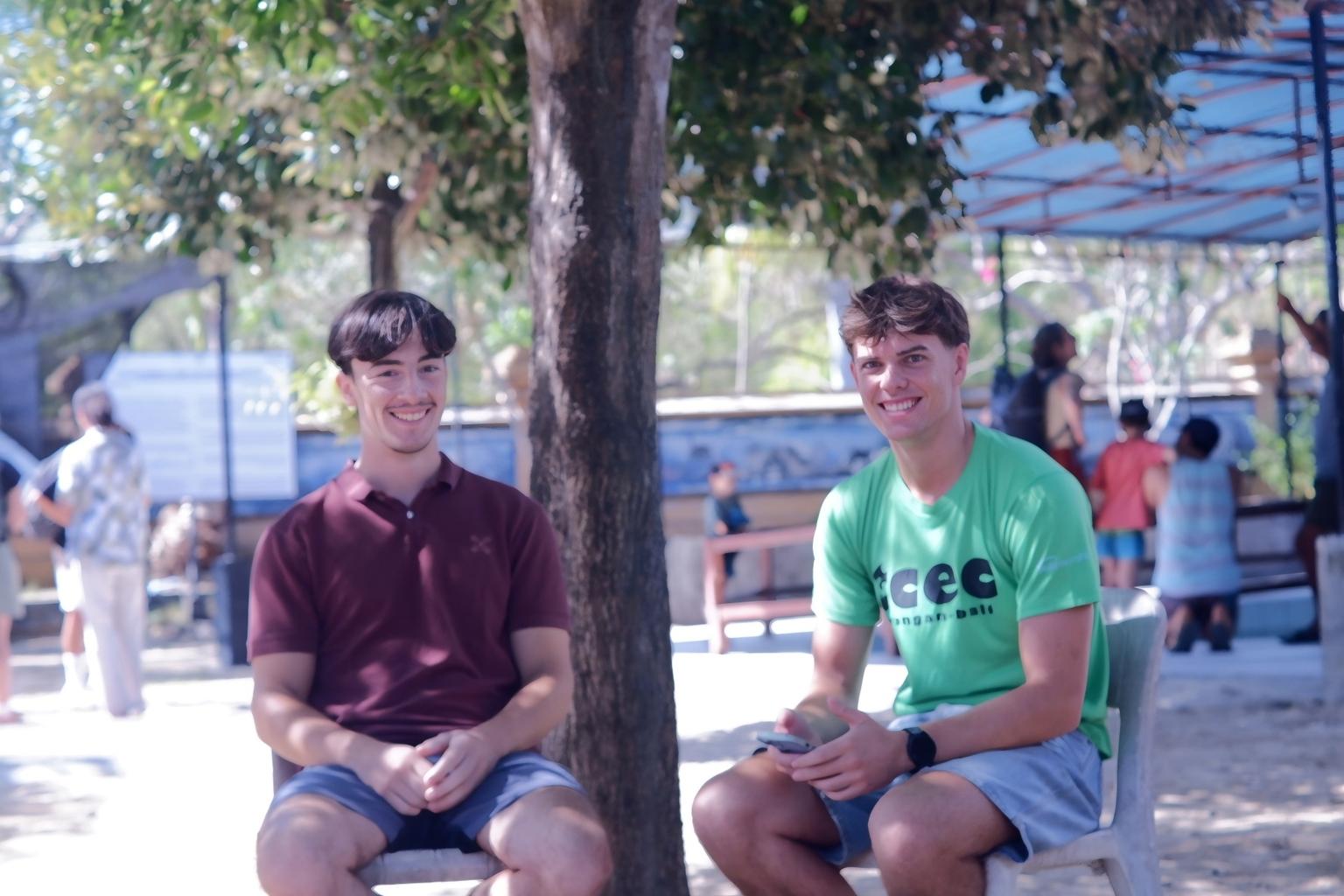
Last internship day: Noé, left, and Riwan on their final day at the turtle conservation center, celebrating three months of learning, friendship, and unforgettable memories in Bali.
Choosing a Different Kind of Engineering Experience
Their decision to come to Bali began with the requirement to gain experience abroad, but both students had personal reasons for choosing the island. Noé was interested in the turtle conservation program partly because it was completely unfamiliar to him. He had little previous knowledge about sea turtles and saw the placement as an opportunity to learn about a new environmental subject while practicing his English. Riwan, meanwhile, wanted an internship that felt more human-centered and would allow him to meet people from Bali as well as participants from other countries.
That choice gave their engineering internship a broader dimension. Their placement was not centered only on technical work or industrial processes. They became involved in the daily operation of a conservation organization, learning how an association functions while participating in activities such as caring for the turtle tanks, supporting visitors, giving tours, and working alongside Indonesian and international volunteers. For students whose previous understanding of professional life had largely been shaped by France and by more conventional company environments, the experience introduced another way of organizing work and another type of workplace altogether.
Riwan later reflected that working in an association was particularly interesting because it was something he had hardly experienced before. He noticed that working in Bali felt different from working in France, not only because of the setting but also because of the mentality and the way people interacted within the organization.
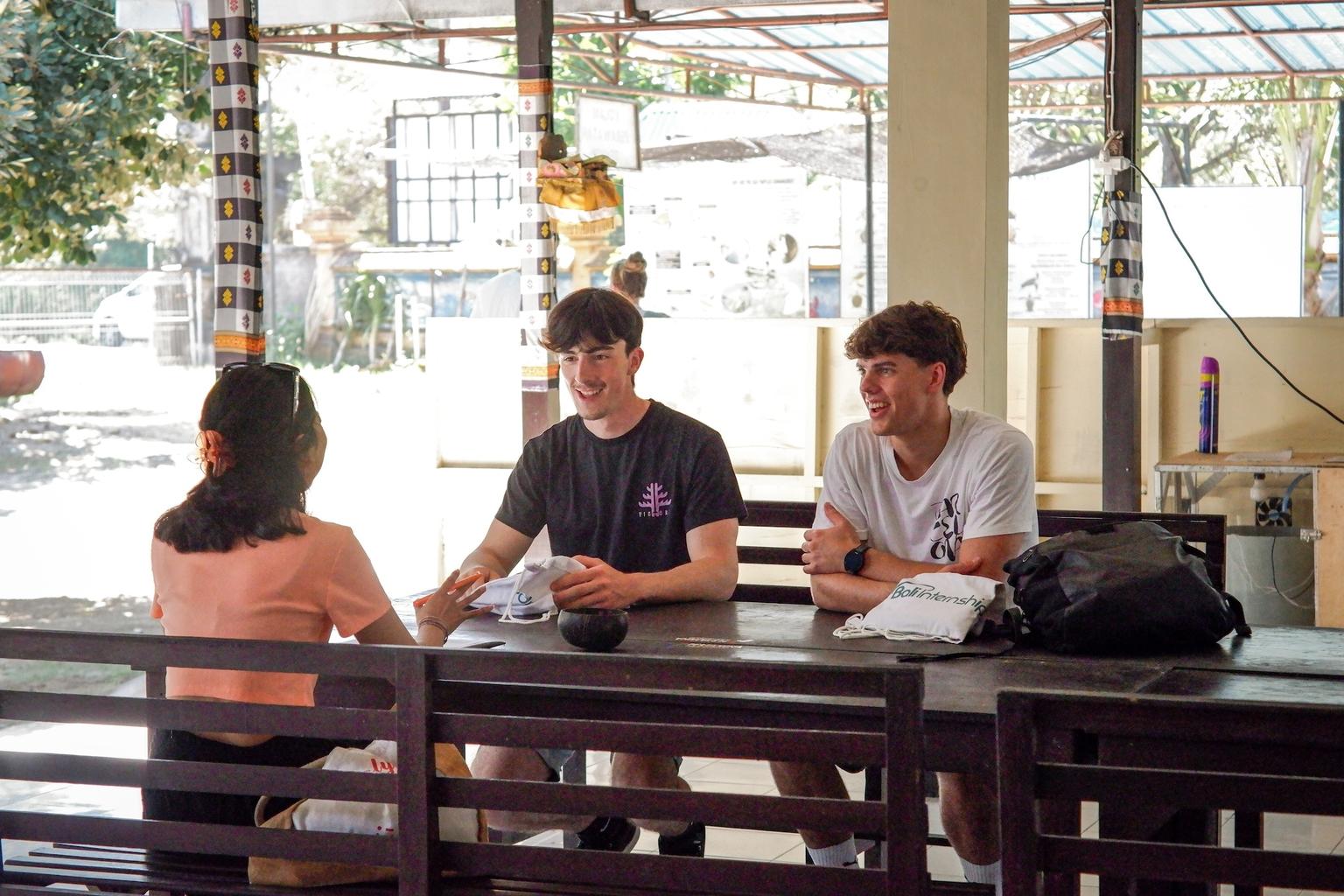
Introduction day: Meeting with our program coordinator on their introduction day, excited and ready to begin their three-month internship in Bali
Learning to Communicate, Not Just Study English
One of the most practical areas of development for both students was English. For Noé, improving his confidence in the language had been one of the main reasons for choosing an international internship in the first place. But practicing English in Bali was very different from studying it in a classroom.
At the conservation center, English became part of everyday life. They used it to communicate with volunteers, visitors, local staff, and people they met outside the workplace. Noé described giving tours to international visitors as one of the most challenging parts of his internship. Explaining information clearly in another language was difficult at first, but over time it became something he was able to do. More personally, he also noticed that he had become much more comfortable speaking to strangers. Before coming to Bali, he sometimes hesitated because he wondered how another person might respond to him. During the internship, he discovered that people were often just as interested in starting a conversation.
This is one of the less visible benefits of an international internship. Language development does not necessarily happen through formal lessons. It develops through repetition, necessity, mistakes, questions, explanations, and ordinary conversations. For Riwan and Noé, English became the language they needed in order to participate in their work and social environment, which meant they were practicing it without separating language learning from daily life.
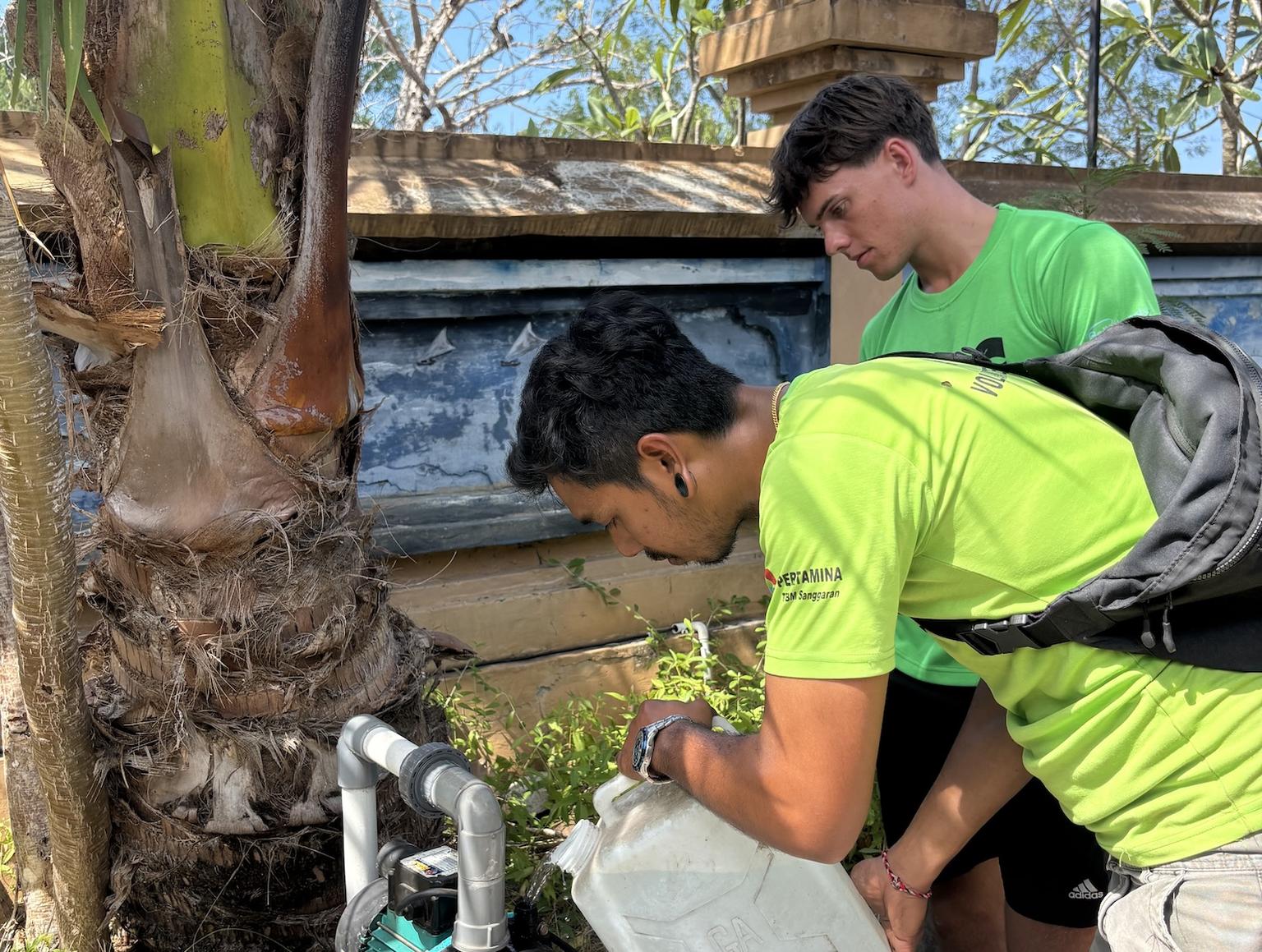
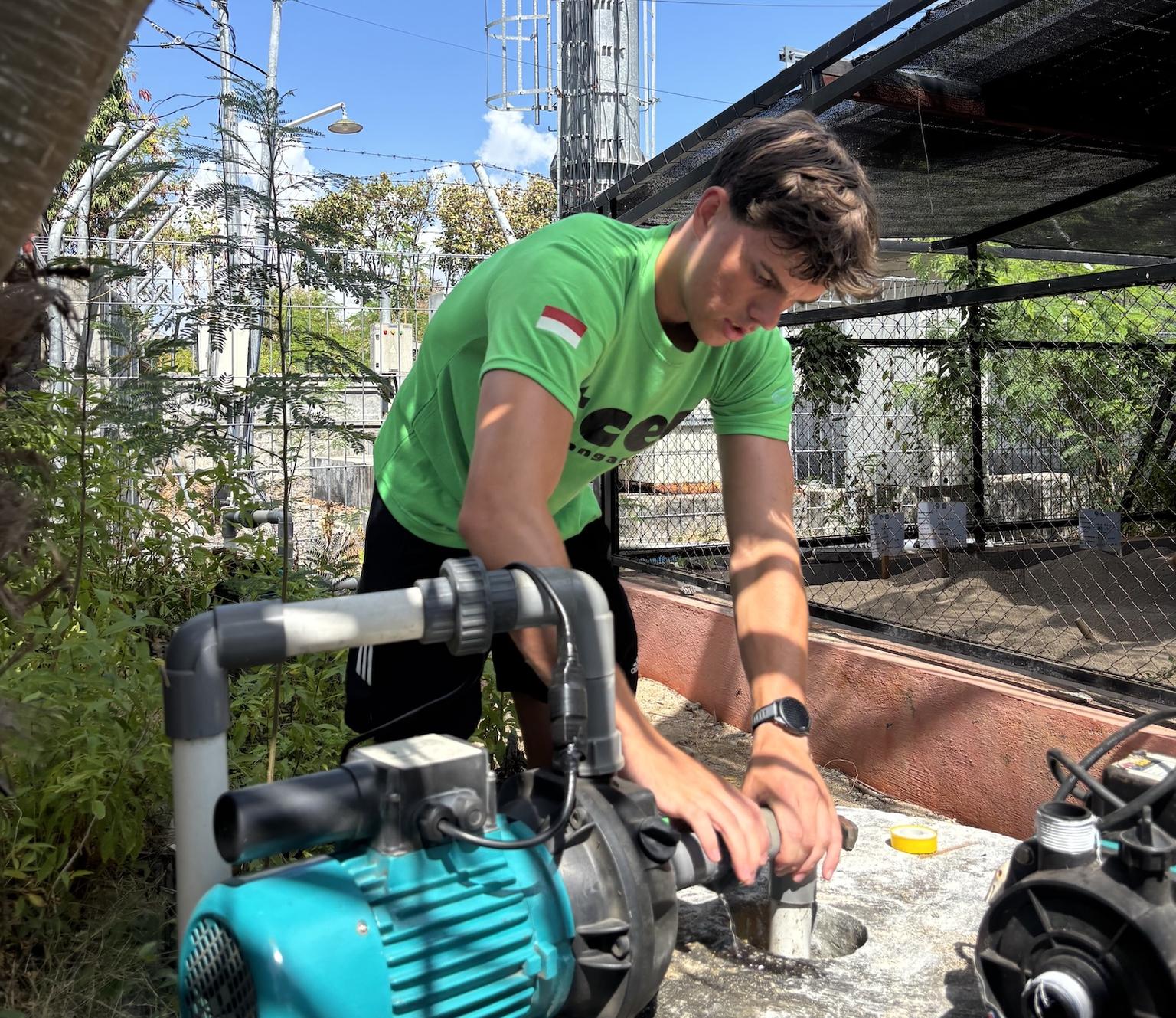
Engineering work at the conservation center Riwan working alongside the conservation center's engineering team while inspecting and maintaining the water-pump system that supports the site's daily operations.
Discovering Bali Together
Traveling alone to another country for several months can be intimidating, particularly for young students who are still early in their professional and academic lives. Noé said having a friend with him made the experience feel easier and safer, while Riwan saw another advantage: being together often helped them meet even more people. One person would start a conversation, another connection would follow, and their social circle gradually expanded.
Their life outside the conservation center became an important part of the international experience as well. With afternoons and weekends available, they explored different parts of Bali, including Nusa Penida, Lovina, Amed, and areas in the north of the island. They surfed, played football with Indonesians, spent time at the beach, and traveled to places that were too far to visit during the working week.
These experiences also brought them closer to aspects of Balinese life that they had not encountered in France. Religion was one of the cultural differences both students noticed most strongly. They were struck by how visible religious practice is in everyday life, particularly when visiting temples and seeing people praying. They also found it easier to speak casually with strangers in Bali than they were accustomed to at home, something Riwan associated with the friendliness they experienced throughout their stay. And, in a slightly less serious cultural observation, he developed a considerable respect for the Balinese tolerance for spicy food.
For Riwan and Noé, the three months in Bali eventually became several experiences happening at the same time. Academically, they completed the international internship required by their engineering studies. Professionally, they experienced a workplace outside the type of company environment they already knew. Linguistically, they used English every day until communicating became more natural. Environmentally, they learned about the life cycle of sea turtles and the threats created by human activity. Socially, they worked alongside Indonesians and volunteers from different countries. Personally, they traveled through Bali together and learned how to navigate a very different cultural environment while still having the familiarity of a close friend beside them.

Bali Internships gathering Noé sharing an Indonesian meal at a Bali Internships gathering, connecting with fellow participants after another week of working and exploring Bali.
Their experience also reflects something useful for other young engineering students considering an internship abroad. An engineering education does not have to limit professional learning to one particular type of workplace. Understanding systems, organizations, communication, teamwork, responsibility, and the social consequences of human activity can happen in many environments, including organizations working in conservation and community-based projects. For students specializing in areas such as industrial management, seeing how different organizations operate can be as valuable as observing another production line or corporate structure.
Even the process of reaching Bali taught them something about planning an international experience. Noé had initially tried contacting companies independently in different countries but found the process difficult. They eventually chose to use Bali Internships because they wanted more certainty around finding an appropriate placement and practical support with their arrival. Once in Bali, assistance with accommodation, airport pickup, a local SIM card, and the steps leading up to the placement allowed them to focus more quickly on the internship itself.
Asked near the end of their interview to describe Bali in only three words, Noé chose “friendly, spicy, and sunny.” Riwan started with “friendly” and “chill,” but struggled to find a third word that felt right. “Amazing,” he decided, was too easy.
After thinking for a moment, he found something better:
“I think it’s a human adventure.”
For two best friends who came to Bali to complete an engineering requirement and ended up learning about conservation, language, work, culture, and each other along the way, that may be the simplest description of the experience.
By LK